Showing posts with label The Stamp. Show all posts

Sunday, 19 February 2012

Which Plate does your Penny Black stamp come from?

To many, the plating of the worlds most famous stamp is a mystery, indeed it was to me when I first started stamp collecting. But the plating of the 1d black can be both absorbing and rewarding. The 1d black was placed on sale to the public on May 2nd 1840 for use on May 6th. It was printed in sheets of 240. From a series of plates, each plate was manufactured from the same master dye. This dye was engraved and hardened before being pressed 240 times on to a softened plate. This plate was then hardened, cleaned and polished and eventually set to print many millions of stamps, 68 million 1d blacks were printed and released from 12 different plates, numbered 1 to 11, plate 1 being 2 plates, the softened version plate 1A and the hardened and longer wearing plate 1B. The plate numbers appeared in the sheet margin at the bottom left and right hand corners. At the end of 1840 it was decided to change the colour of the stamps to red brown as the black cancellers used in the later stages of this issue did not show up too clearly on the black stamp. Plate 11 was the first plate produced solely for printing stamps in the new red brown shade, due to last minute shortages of the black stamp before the red could be issued, it was, for two days only, used as an emergency to supply the late demand. Plate 11 therefore is by far the rarest of all the 1d blacks and is highly sought in any condition.
 
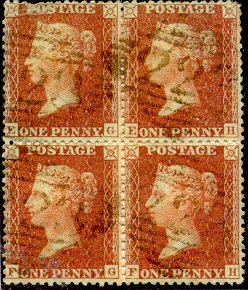
In order to plate a 1d black we must first look at the corner letters, on each sheet there are 240 differently lettered stamps, the first stamp of the top row is lettered AA. The row continues to AL and then starts at the 2nd row BA to BL and so on throughout the sheet until the final row TA to TL. These letters are the only part of the design that was put in my hand. After the steel dye had been rolled 240 times to produce the plate, the letters were then punched in. It is therefore possible to collect a 1d black lettered say, AA from each plate, although the stamps looks identical it can be seen that in each case the letters differ in position, some may be high, others low or to the left or right, some may be crooked or doubled where the punch was struck twice, so these letters play an important role in plating the black. As the dye was pressed during the manufacture of this plate, weakness occurred, some of the arms of the top left hand star became invisible in certain plates, known as the 5 o clock, 7 o clock ray flaws because of their positions on the clock face appearance of the star. These rays became faint and disappeared and this clue is a guide to some plates. Let us suppose that a 1d black shows a ray flaw in the top left star, as this was only found on plates 1A, 1B and 2, then it must come from one of these three. The engravers finally saw what had happened and retouched the dye, so this clue has your black almost plated, but there are other clues, the O flaw, where the O in one of one penny grows a leg, much like a Q in appearance. Plates 7, 8, 9 and 10 have this flaw, it is faint in plate 7 but gets worse in plate 10 and there are three stages of the flaw, known as O flaw 1, 2 and 3. Faint to pronounced as the dye works through the four plates. Plate 11 has a single flaw that sets it apart from the others. A 7 o clock ray flaw in the right star. It is completely missing and very clearly so, it is the easiest and rarest of blacks to plate.


If a stamp is on a dated cover, your chances of finding its plate are even better, if the cover is dated say August 1840, then that black can only come from 1 to 6, as later plates were not set for printing until after this date, if the stamp shows no ray flaws then it must be from plate 3, 4, 5 or 6. Narrowing the field by eye is relatively simple, it is when you want to pin point the plate that you must look closer at your black much closer in fact for fainter, slighter clues are hidden in this most perfect of designs. With a strong glass (a watch makers glass in perfect) and a good light, there are many tiny flaws that show up as pointers to the correct plate. 'Re entries'. The most substantial variety, where the roller impression on the newly prepared plate was not firm enough, resulting in loss of design. The engravers sometimes rolled the impression over again or re entered the design by hand, engraving or touching up lines or strokes, usually visible in the corner stars, they look hairy or bitty with doubling or odd marks that should not be there. Also marks in the wording and lower squares 'Guide Lines'. Simply lines scratched on to the plate to guide the dye roller, usually seen horizontally or vertically in the star and letter squares and sometimes through the value wording, fairly clear to see in most cases. 'Extended Lines'. Going past the design at the corners. 'Dots and Spots'. Again for guiding purpose in laying the plate. All over the place but generally in or around the letter squares. 'Double or crooked letters'. A good guide. 'The colour of the cancel', red for early plates, black for later plates although all plates can be found in RED and BLACK, but a reasonable guide especially for plate 10, which is rare, with red cancel and plate 11, which is almost always in black.

But to be honest it is impossible for all but the true black specialist to plate a stamp by eye, if you handle them in quantity which is a dream of course we would all like to realise, then with careful study you can plate more or less without turning to the reference works on the subject. If however you have just a few blacks then you will need to get a book and use it with this short guide. Gibbons specialist red book vol 1 is a good aid, although not outstanding. 'The Postage Stamps of Great Britain Vol 1' by Seymore is better and if you have both books it is easier. Ormond plating cards in folder give a good break down with most flaws listed, but by far the best book is 'Guide lines to the Penny Black' by Litchfield, with almost 100% success every time. Plating the 1d black is not easy but it is a most rewarding and worthwhile pastime that can be polished to a fine art. Plating penny reds is exactly the same but much harder, as instead of twelve plates to choose from, there are over 170, but it is always a delight to turn the page of a collection and see a fine plated set of penny blacks. Yes, very nice indeed.

credit: http://stevenallenstamps.com/archive/how-plate-1d-black

Friday, 24 June 2011

Recommended Books on Great Britain Postage Stamps 1840-1901

Catalogues
1. Stanley Gibbons. Great Britain Specialised Stamp Catalogue Vol 1: Queen Victoria 15th ed. 2008 (new edition every ~2-4 years) a "Must Have" for the QV specialist
2. Collect British Postmarks: The Handbook to British Postal Markings and Their Values, J.T.P. Whitney
3. GB Concise. Useful as a handy reference, useful if you do not want to become too specialised or if you just want updated catalogue values (new edition every year)

Historical Info  
1. Robson Lowe. The British Postage Stamp of the nineteenth century, 1968 (This is an excellent book both for historical info and pictures of rare Victorian stamps)

Plating guides  
1. J B Seymour and C. Gardiner-Hill. The Postage Stamps of Great Britain. Part 1 Imperforate line-engraved Issues (useful for historical info, this contains sheet marginal markings of line-engraved stamps)
2. Litchfield, Guide lines to the Penny Black

Source: http://www.imagesoftheworld.org/stamps/books.htm

Imperforate Penny Blacks

Penny Black stamps were imperforate. This meant that the postmaster or mistress had to cut out the stamps from the sheet by hand. As a result of careless cutting, many of the stamps have incomplete margins, the cuts often extending into the printed area of the stamp.


Because the Penny Blacks were not perforated, the seller had to cut out the stamps from the sheet using scissors or a knife. There was only about 1mm between the stamps and it was not unusual to accidentally cut into the printed section of the stamp, resulting in irregular margins. The number, size, and regularity of the margins make all contribute to the value of the Penny Black stamp. For example, a Penny Black with two full margins and a reasonable amount of the other two margins is regarded as an average specimen. Stamps with four, regular margins are exceptional, and collectors will pay higher prices for these stamps.

Between 1848 and 1854 trials were carried out in order to find a better and more acceptable way of separating stamps than the scissors and in early 1854 the first ‘perforated’ penny red was issued. 


Source: http://www.pennyblackstamp.co.uk/printing_penny_black_stamps.html

Buying Penny Blacks from eBay

All in all, knowledge is power. Buy from a reputable source for a peace of mind. Here at Pennyblackstore, we offer stamps that are genuine and of high quality, assuring collectors stamps of value. The main problem when buying Penny Black stamps is that there are many forgeries on the market. For example, an expert forger can take a stamp and 'clean' it so that it appears to be in mint condition. Evidence of cleaning can only be confirmed by expert dealers such as Stanley Gibbons in London. Here are some tips to follow when buying Penny Black stamps on eBay:


1. If you buy from an auction, always make sure you have full contact details of the person who sold you the stamp.
2. Take it to an expert dealer for valuation if you are unsure. 
3. Never bid for a stamp if the photograph looks vague or blurred or the wording of the listing is ambiguous.
4. Feedbacks scores are a good indicator of a sellers reliability, but be cautions. Some people selling stamps might not be aware themselves that they are selling forgeries.
5. Always pay with PayPal as this will allow you to open a dispute if a Penny Black stamp that you buy turns out to be a forgery. Once you supply a written description of the true nature of the stamp provided by an expert, PayPal will refund your money.

Source: http://www.pennyblackstamp.co.uk/buying_penny_black_stamps_on_ebay.html

Tuesday, 21 June 2011

Recommended Books

Guide Lines to the Penny Black by P.C. Litchfield 
One of the most authoritative guides on the Penny Black. This book provides a detailed description of each one of the 2880 stamps produced and the plates from which it was printed. This book was originally published in September 1949 and remains an essential guide for anyone who collects Penny Black Stamps or who is interested in early Victorian line engraved issues. Litchfield takes the reader through the varied history of the Penny Black stamp providing clear explanations of how it was produced from its initial conception and design to the finished product. The book looks at the setting of the soft steel rollers, the hardened steel plates and defects in the printing technique that results in flaws. Litchfield lists the position of every letter from AA, AB, AC etc. to TJ, TK and TL. He also notes the characteristics of a stamp that may help link the stamp to a particular plate. These oddities are printing defects such as the presence ray flaws, “O” flaws, guide lines or double impressions. The book is currently out of print but second hand copies can be obtained from Amazon or occasionally on ebay.


External Book Review:
Nearly sixty years after it was originally published in September 1949 P.C. Litchfield's Guide Lines to the Penny Black remains a must have for any stamp collector who is serious about collecting the Penny Black stamp or whose stamp collection centres on early Victorian line engraved issues. Litchfield's lively history and clear explanations of the entire process of creating the world's first stamp from its initial conception and design through to the setting of the soft steel rollers and eventual hardened steel plates and the consequential tell-tale “defects” that this complicated procedure left behind is essential reading for all philatelists regardless of their individual specializations.

Undoubtedly Litchfield's greatest contribution to the study of the Penny Black, as the title suggests, is in his guide lines to identifying and plating individual stamps. Starting at check letters AA, then AB, AC etc. working through to TJ, TK and TL, he lists the position of each and every letter and notes all known oddities that may help link the stamp to a particular plate such as the presence or not of ray flaws, “O” flaws, guide lines or double impressions. Illustrated throughout with helpful diagrams, this is a book philatelists of all ages and experiences will turn to again and again.

Source: http://www.pennyblackstamp.co.uk/penny_black_books.html 
http://www.pennyblack1840.com/guidelines-to-the-penny-black/ 

Sunday, 19 June 2011

Watermarks, Check letters and Cancellations

Watermarks, Check letters and Cencellations on the Penny Black
Source: http://www.pennyblack1840.com

Penny Black Facts

The Penny Black
1. The Penny Black was the world's first official adhesive postage stamp. It was issued on 1st May, 1840 and in use from 6th May, 1840. However, in use for just over a year.

2. This world famous and much loved stamp features a portrait of the young Queen Victoria.

3. It was printed using the line engraved printing method from 11 plates numbered 1 to 11, although plate 1 deteriorated quickly and was repaired to such an extent that it is generally considered as two separate plates - 1a and 1b - making 12 plates in total.

4. The stamps were printed on large sheets each containing 240 stamps which were cut apart by scissors.

5. To prevent forgery, the stamps had small crown watermarks on the back and check letters in the bottom corners.

6. The letters were impressed by hand with a punch.

7. The letters were marked 'A' through 'T' horizontally on the plate and 'A' through 'L' vertically so 'AA' was found at the top left of the sheet and the final stamp position at the bottom right was 'TL'.

8. The Penny Black was initially cancelled by a red Maltese Cross cancellation however this was both difficult to see and easy to remove on a black stamp. After a brief period of using black ink cancellations the Penny Black was replaced by the Penny Red.

9. What had cost say 1 shillings and 1½ dime, suddenly cost a mere 1d, a drop of more than 92 per cent.

10. At the same time as the penny black, Hill launched prepaid / pre-stamped sheets ready for the user to write and fold, but the public preferred the gummed stamp for use with their own stationery.

11. The penny black was printed by Perkins Bacon in sheets of 240, 12 across the top x 20 deep. It featured a cameo portrait of Queen Victoria , taken from a picture painted when she was just 15.

12. The Penny Black started two precedents still holding today: that British stamps do not feature the name of the country unlike other stamps; and the monarch’s face appears facing to the left, as per the penny black.

13. May 6 was the official launch date of the stamp, but copies were delivered to Post Offices on May 1, and some jumped the gun, thus one cover exists with a cancellation date of May 1, and quite a few have been found with May 2, when they were not yet legal.

14. The penny black was only short-lived, as the red ink used to cancel the thing showed up poorly, and was easy to remove to allow the stamp to be reused, so the following year a penny red was issued, and more permanent black ink used to cancel it.

15. It is thought that well over a million penny blacks exist today in philately collections around the world, poor examples selling for just a few pounds, but rarer ones far more – mint examples from the rarest plate used, plate 11, would cost several thousand pounds.

Sources: 1-8 http://www.pennyblack1840.com/facts/
9-15 http://www.information-britain.co.uk/famdates.php?id=531

Perkins D Cylinder Printing Press

This machine printed the original Penny Black and Two Pence Blue postage stamps first issued in May 1840. The inventor of the machine, Jacob Perkins, was an American living in London. The machine is exhibited at the British Library in London. It was patented in 1819. The sheets, printed by Perkins Bacon, consisted of 240 stamps in 20 rows and 12 columns. As the name suggests, the stamp was printed in black ink. Two values were to be printed, the 1d in black and the 2d in blue. When the die, engraved in reverse, was complete it was transferred by a roller to the plate 240 times and then the individual corner letters were punched in. Printing of the 1d labels on watermarked paper began on 11 April and on 1 May both it and the Mulready stationery were put on sale in London, becoming valid for postage on 6 May. By then some 600,000 labels were being produced daily. The 2d label followed, printing only beginning on 1 May 1840.

Perkins D cylinder Printing Press
Photograph 2006 by Jacqueline Banerjee. 
http://www.victorianweb.org/technology/print/1.html 
http://www.oobject.com/12-vintage-printing-presses/penny-black-printing-press-1840/6259/
Source: http://en.wikipedia.org/wiki/Penny_Black 
http://postalheritage.org.uk/page/pennyblack

Determining the Value of Penny Blacks

How can one determine the value of a Penny Black Stamp? A good reference for stamp collectors is the Stanley Gibbons Price Catalogue that will provide an indication of the stamp's worth. The Stanley Gibbons code for Penny Blacks has a SG prefix followed by the plate number. There were 11 plates for the Penny Black with 12 unique codes: Plate 1a, Plate 1b, followed by 2 to 11. Apart from the Stanley Gibbons guide, you can also ask for an expert valuation from a stamp dealer, and is best to seek a few opinions.

As a generalisation, the value of stamps can be determined by three major factors: its rarity, the condition and the supply (availability). The condition of a stamp can be further determined by the following order:

- Unmounted Mint, Never hinged 
- Fine Mint, Hinged Mint
- Mint 2nd, Mint with faults 
- Fine Used, Fair condition light postmark
- Good Used, Heavier postmark
- Used 2nd, Used with faults

The Penny Black
Source: http://pennystamp.co.uk/penny-black-stamp-value.html

Sheet Layout of the Stamps

The image below shows the sheet layout of the stamps. This location is identified by one letter on the bottom left and another on the bottom right.

Sheet Layout of the Stamps

The Penny Black Stamp

The Penny Black
The stamps were printed in sheets of 240, engraved on steel plates, on gummed paper with a single small crown watermark on each stamp. Eleven different printing plates were used during the life cycle of the Penny Black. Every penny black stamp has letters in the lower two corners. These simply identify what sheet position the stamp occupied. There were 68,158,080 penny blacks issued. The stamps were not perforated, and had to be separated using scissors or a knife. As there was only about 1mm between one stamp and another, it was very easy to stray just a little and cut into the printed design of the stamp. Some 11 plates were used to print the 1d Penny Black, producing over 68 million examples. Only two plates were made for the 2d value. There was a proposal for government versions with the letters 'V R' in the top corners but this was abandoned. 

Source: http://postalheritage.org.uk/page/pennyblack